


AI for Techies
Green Belt Program
A 40–50 hour code-first program for developers, engineers, and tech leads. Build, integrate, and deploy AI-enabled applications and agentic workflows — safely and responsibly, without needing enterprise-scale architecture.
Python
LangChain
LlamaIndex
OpenAI API
Anthropic API
Gemini API
Ollama
HuggingFace
- 40–50 Hours | 6 Modules
- Code-First | Labs Every Module
- AI Green Belt – IT Certified
- Prerequisite: AI Yellow Belt
Send an Enquiry
Thank you! Your submission has been received!
Oops! Something went wrong while submitting the form.
1,00,000+
Skills
11,000+
Free COURSES
1,500+
Skills ASSESSMENTS
500+
Enterprise Employers
A Complete AI Engineering
Skill System for Developers
Six code-first modules that take you from LLM fundamentals through to building production-grade agentic workflows — with hands-on labs in every session.

Generative AI Fundamentals for Devs

Building AI Apps, Tools & Patterns

RAG — Retrieval & Grounding Systems

Agentic AI — Agents & Orchestration

LLM Testing & Evaluation at Scale

Capstone — Deployable AI App or Agent
6 Modules. Real Code.
Production-Ready Output.
A 40–50 hour code-first journey from LLM fundamentals to deploying
agentic AI workflows — with hands-on labs, real tools, and a portfolio-ready capstone.
agentic AI workflows — with hands-on labs, real tools, and a portfolio-ready capstone.
Generative AI Fundamentals for Developers
MODULE 1
Building AI Apps — Prompts, Tools & Patterns
MODULE 2
RAG — Retrieval & Grounding (Applied)
MODULE 3
Agentic AI — Agents, Tools & Orchestration
MODULE 4
LLM Testing & Evaluation at Scale
MODULE 5
Capstone Project — AI App or Agentic Workflow
MODULE 6
Track Your AI Readiness Journey
Industry-recognised credentials that validate your AI engineering
execution capability.
execution capability.

Verified Certifications

Hands-on Learning Experience

Progress Visibility & Outcomes
Jointly Awarded by IIIT Delhi Innovation
and Incubation Center
& Skills Caravan
Upon successful completion of all 6 modules and capstone project, participants receive a
co-branded certificate recognised by top engineering and product organisations across India and globally.
co-branded certificate recognised by top engineering and product organisations across India and globally.

* Sample certificate. Your name and unique Certificate ID will appear on the issued credential.
Learn From Practitioners
Our trainers bring real-world AI engineering experience from
India's leading product companies, cloud platforms, and research institutions.
India's leading product companies, cloud platforms, and research institutions.

M.S.BITS Palani
FounderVIHU AI, EX – AWS
FounderVIHU AI, EX – AWS
Amit Gupta is anexperienced AI and technology leader with deep expertise in Generative AI,Agentic AI, and enterprise automation. With a strong background in buildingintelligent AI-driven solutions, he specializes in designing autonomous AIagents, workflow automation, and practical business applications of AI. Hebrings a hands-on industry perspective, helping professionals understand howAgentic AI can transform decision-making, productivity, and real-world businessoperations.

Data Scientist, Synechron,
IIT Jammu
IIT Jammu
Rajesh Thakur is a seasoned Data Scientist and AI professionalwith over 7+ years of experience specializing in Generative AI, MachineLearning, and enterprise AI solutions. With strong expertise in buildingintelligent systems, LLM applications, and AI-driven automation, he focuses ontransforming complex business challenges into scalable AI solutions. Hishands-on industry experience in data science, deep learning, and Agentic AIenables learners to gain practical insights into real-world AI implementationand autonomous agent workflows.

B.E. TSEC
Founder Amquest Education,
Ex-CTO CoutLoot
Founder Amquest Education,
Ex-CTO CoutLoot
Nicky Sidhwani is a technology and business transformation leader with strongexpertise in Generative AI, Agentic AI, and enterprise automation. Withexperience working at the intersection of AI, business systems, and real-worldexecution, he focuses on building industry-ready learning models that bridgethe gap between education and employability. As a key force behind AmquestEducation, he brings deep insights into AI-driven business transformation,autonomous agent workflows, and practical applications of AI across finance,marketing, and technology domains
Why Engineering Teams Choose Us
Our comprehensive solution is crafted to unlock your engineering team's full AI capability in production environments.

Code-First, Production-Grade
Not a no-code overview — every module uses Python, LangChain, LlamaIndex, and real APIs. Labs produce code you can actually use in your codebase.

Built for Engineering Enterprises
Fully customisable and integrates with your existing CI/CD, LMS, and tech stack. Supports both cloud-hosted and on-premise model deployments.

Safe & Responsible AI by Design
Every module covers safeguards, human oversight, failure handling, and responsible deployment — not just capability. Build AI you can trust in production.

Live Analytics & Tracking
Real-time progress dashboards and leaderboards for individual engineers, team leads, and L&D managers across the full program lifecycle.

Gamification & Peer Learning
Badges, certificates, code reviews, and peer capstone presentations make AI engineering training engaging and collaborative for technical teams.
Loved by Industry Leaders
Uncover the impact and success stories shared by our valued users who have embraced innovation and witnessed transformative results.

"We at Indifi, believe in future proofing our peoplethrough continuous up-skilling across relevant domains. Skills caravan has beena valuable learning partner in driving our AI readiness journey. Theirthoughtfully curated learning approach for this program, which entails a seriesof webinars has significantly enhanced learner engagement. The hands onapproach during these webinars is targeted at capability enhancement acrosslevels on AI. Look forward to more such meaningful partnerships toward buildinga future-ready organization"

Anubhav Saxena
Head- Learning & Development
Indifi
" This is an appreciation note for the AI Yellow Beltsessions you are running for our organisation Your sessions stand out forenforcing continuity and for the hands-on practice you require within theallocated learning time. Thanks once again"

Qudrat Bhatia
Head- People and Performance
Al Yousuf Group
"Honestly, the AI Readiness sessions from Skill Caravan havebeen a breath of fresh air. Our team didn't just get a bunch of theory; theywalked away with the actual confidence to use AI in their day-to-day work. Thefeedback across the organization has been fantastic, people are actuallyexcited about the personalized suggestions the platform gives them. If you wantto get your team comfortable with AI without the usual corporate fluff, theseguys are the way to go"

Sushanth Sabineni
Learning & Development Manager
Learning & Development Manager


Course Details & Pricing
Choose the plan that works for your learning — individual enrollment
or bulk nominations for your engineering team.
or bulk nominations for your engineering team.
INDIVIDUAL
AI for IT — Green Belt
- 40–50 Hours across 6 modules
- Code-first, labs every session
- Python, LangChain, LlamaIndex
- OpenAI / Anthropic / Gemini APIs
- RAG pipeline you can deploy
- Multi-step agent workflow
- LLM evaluation & testing system
- AI Green Belt – IT Certificate
Course ID : 13436
Course Price at
₹ 40,000 + 18% GST
CORPORATE / BULK
Team & Enterprise Enrollment
- Minimum 5 nominations
- Dedicated L&D dashboard
- Progress tracking & reporting
- Branded certificates available
- Volume discount pricing
- Dedicated program manager
Course ID : 13436
Pricing based on team size
Custom Quote
Bulk discounts from 5+ seats
Bulk discounts from 5+ seats
Empower Your Engineering Team with
Production AI Skills
Our comprehensive solution is crafted to unlock your engineering team's full AI capability.
Start building AI features that are reliable, grounded, and production-ready.
Start building AI features that are reliable, grounded, and production-ready.
Course details and Pricing
Select Course Date
2026-03-18
2026-03-18
2026-03-22
2026-03-26
2026-03-26
2026-03-30
2026-04-02
2026-04-06
2026-04-10
2026-04-14
2026-04-18
2026-04-22
2026-04-22
2026-04-26
Frequently Asked Questions
Everything you need to know about the AI for IT Green Belt —
the stack, curriculum, certification, and what you walk away with.
the stack, curriculum, certification, and what you walk away with.
Who is the AI for IT Green Belt program designed for?
What is the tech stack and what will I actually build?
What certification do I receive and how is it recognised?
What is RAG and why does every AI developer need to learn it?
What is agentic AI and how is it different from building a chatbot?
Why is LLM testing and evaluation its own module?
What does PromptOps mean and why should developers care?
What are the capstone project options and what makes a strong submission?
1,00,000+
Skills
11,000+
Free COURSES
1,500+
Skills ASSESSMENTS
500+
Enterprise Employers
A Complete AI Engineering
Skill System for Developers
Six code-first modules that take you from LLM fundamentals through to building production-grade agentic workflows — with hands-on labs in every session.
Generative AI Fundamentals for Devs
Building AI Apps, Tools & Patterns
RAG — Retrieval & Grounding Systems
Agentic AI — Agents & Orchestration
LLM Testing & Evaluation at Scale
Capstone — Deployable AI App or Agent
6 Modules. Real Code.
Production-Ready Output.
A 40–50 hour code-first journey from LLM fundamentals to deploying
agentic AI workflows — with hands-on labs, real tools, and a portfolio-ready capstone.
agentic AI workflows — with hands-on labs, real tools, and a portfolio-ready capstone.
Generative AI Fundamentals for Developers
MODULE 1
Building AI Apps — Prompts, Tools & Patterns
MODULE 2
RAG — Retrieval & Grounding (Applied)
MODULE 3
Agentic AI — Agents, Tools & Orchestration
MODULE 4
LLM Testing & Evaluation at Scale
MODULE 5
Capstone Project — AI App or Agentic Workflow
MODULE 6
Track Your L&D Success
Industry-recognised credentials that validate your AI engineering
execution capability — jointly awarded by IIIT Delhi and Skills Caravan.
execution capability — jointly awarded by IIIT Delhi and Skills Caravan.
Verified Certifications
Track L&D Success
Global Recognition
Jointly Awarded by IIT Delhi
& Skills Caravan
Upon successful completion of all 6 modules and capstone project, participants receive a
co-branded certificate recognised by top engineering and product organisations across India and globally.
co-branded certificate recognised by top engineering and product organisations across India and globally.
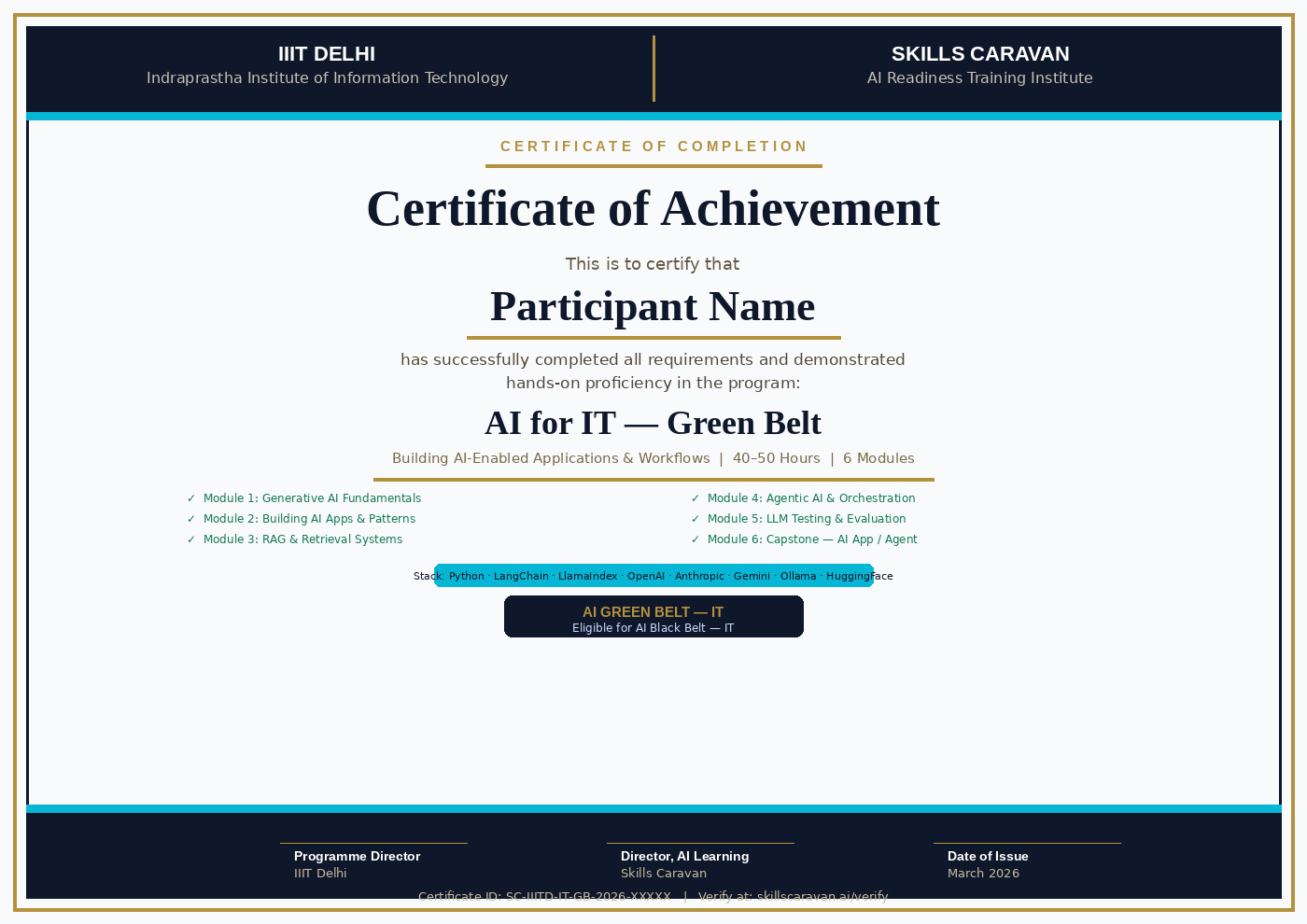
* Sample certificate. Your name and unique Certificate ID will appear on the issued credential.
Learn From Practitioners
Our trainers bring real-world AI engineering experience from
India's leading product companies, cloud platforms, and research institutions.
India's leading product companies, cloud platforms, and research institutions.

Arjun Krishnan
AI Engineering & LLM Systems Lead
14+ years building production AI and NLP systems. Ex-Google DeepMind India and IIT Madras AI Lab. Specialises in LangChain architectures, RAG systems, and LLM evaluation at scale.
Sneha Pillai
Agentic AI & MLOps Architect
11+ years shipping agentic workflows and ML pipelines for fintech and SaaS products. Expert in multi-agent orchestration, human-in-the-loop design, and production AI deployment on AWS and GCP.
Rahul Gupta
Generative AI & Developer Tools Expert
10+ years in developer tooling, prompt engineering, and AI application development. Has led AI readiness programs for engineering teams at India's top IT services, product, and startup organisations.
Why Engineering Teams Choose Us
Our comprehensive solution is crafted to unlock your engineering team's full AI capability in production environments.
Code-First, Production-Grade
Not a no-code overview — every module uses Python, LangChain, LlamaIndex, and real APIs. Labs produce code you can actually use in your codebase.
Built for Engineering Enterprises
Fully customisable and integrates with your existing CI/CD, LMS, and tech stack. Supports both cloud-hosted and on-premise model deployments.
Safe & Responsible AI by Design
Every module covers safeguards, human oversight, failure handling, and responsible deployment — not just capability. Build AI you can trust in production.
Live Analytics & Tracking
Real-time progress dashboards and leaderboards for individual engineers, team leads, and L&D managers across the full program lifecycle.
Gamification & Peer Learning
Badges, certificates, code reviews, and peer capstone presentations make AI engineering training engaging and collaborative for technical teams.
Partner Ecosystem
Access curated content from Skillsoft, Coursera, Udemy Business, and 10+ certified learning partners alongside the core engineering curriculum.
Loved by Industry Leaders
Uncover the impact and success stories shared by our valued users who have embraced innovation and witnessed transformative results.
"The RAG module was exactly what our backend team needed. We shipped a document QA feature in two weeks after the lab — the pipeline structure from the course went almost directly into production."

Anurag Anand
Head of Engineering
HMCMM, JV of Hero MotoCorp
"The Agentic AI module changed how our platform team thinks about automation. We now design human-in-the-loop workflows by default — the approval checkpoint pattern from Module 4 is in every AI feature we ship."
Deepak Rathish
Lead Engineer & AI Platform
UTI Mutual Fund
"Skills Caravan's LLM evaluation module solved a real pain point. We finally have automated regression tests for our AI features — we know immediately when a model or prompt change breaks something."
Sudhir Narayanan
DGM Engineering & AI Platform
Shoppers Stop
"Skills Caravan's LLM evaluation module solved a real pain point. We finally have automated regression tests for our AI features — we know immediately when a model or prompt change breaks something."
Sudhir Narayanan
DGM Engineering & AI Platform
Shoppers Stop
Course details and Pricing
Select Course Date
2026-03-18
2026-03-18
2026-03-22
2026-03-26
2026-03-26
2026-03-30
2026-04-02
2026-04-06
2026-04-10
2026-04-14
2026-04-18
2026-04-22
2026-04-22
2026-04-26
Course Details & Pricing
Choose the plan that works for your learning — individual enrollment
or bulk nominations for your engineering team.
or bulk nominations for your engineering team.
INDIVIDUAL
AI for IT — Green Belt
- 40–50 Hours across 6 modules
- Code-first, labs every session
- Python, LangChain, LlamaIndex
- OpenAI / Anthropic / Gemini APIs
- RAG pipeline you can deploy
- Multi-step agent workflow
- LLM evaluation & testing system
- AI Green Belt – IT Certificate
Course ID : 13436
Course Price at
₹ 40,000 + 18% GST
CORPORATE / BULK
Team & Enterprise Enrollment
- Minimum 5 nominations
- Custom cohort scheduling
- Dedicated L&D dashboard
- Progress tracking & reporting
- Branded certificates available
- LMS / HRMS integration
- Volume discount pricing
- Dedicated program manager
Course ID : 13436
Pricing based on team size
Custom Quote
Bulk discounts from 5+ seats
Bulk discounts from 5+ seats
Empower Your Engineering Team with
Production AI Skills
Our comprehensive solution is crafted to unlock your engineering team's full AI capability.
Start building AI features that are reliable, grounded, and production-ready.
Start building AI features that are reliable, grounded, and production-ready.
Frequently Asked Questions
Everything you need to know about the AI for IT Green Belt —
the stack, curriculum, certification, and what you walk away with.
the stack, curriculum, certification, and what you walk away with.
Who is the AI for IT Green Belt program designed for?
What is the tech stack and what will I actually build?
What certification do I receive and how is it recognised?
What is RAG and why does every AI developer need to learn it?
What is agentic AI and how is it different from building a chatbot?
Why is LLM testing and evaluation its own module?
What does PromptOps mean and why should developers care?
What are the capstone project options and what makes a strong submission?
Enroll Now
Follow the steps

Step 1 : Pay ₹40,000 for
Course ID : 13436
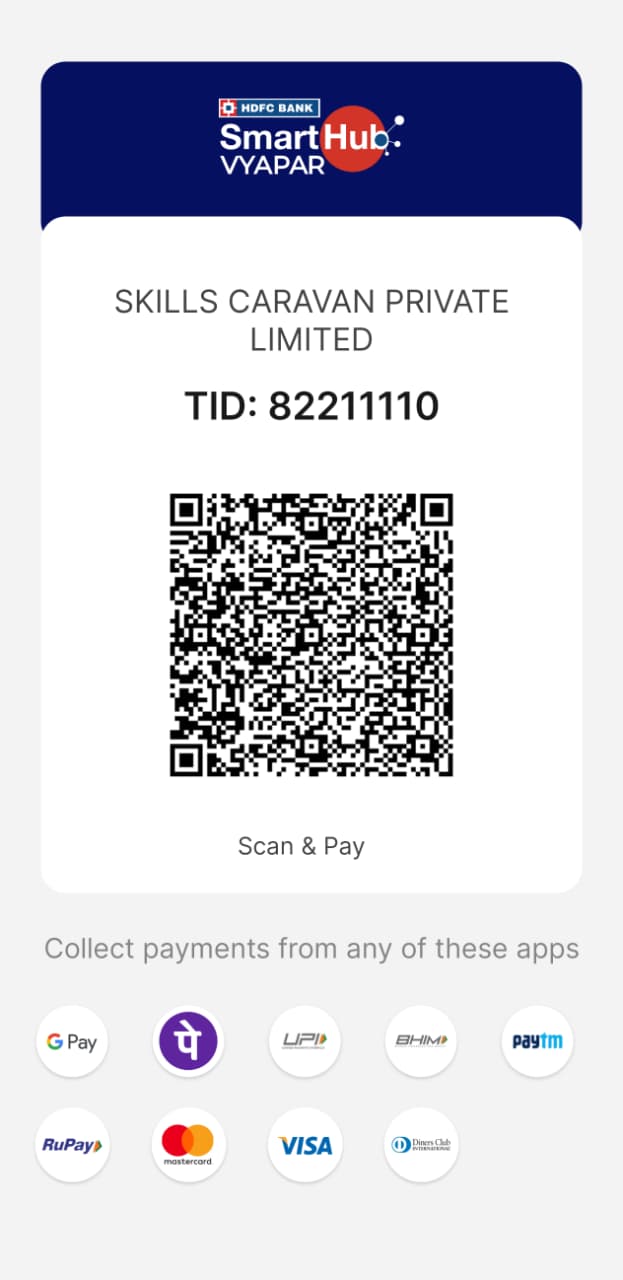
Step 2 : Fill the below form accurately
Thank you! Your submission has been received!
Oops! Something went wrong while submitting the form.