


Skillsoft
Skillsoft is a global leader in corporate learning, providing digital training and education solutions to help businesses improve workforce productivity, reduce risk, and increase innovation.


Most organizations invest heavily in developing their people, yet few can answer a simple question with data: how capable is our workforce, really — and against what standard? Development without that answer is motion without direction. You run training, people attend, and no one can say whether capability actually moved or where it still falls short. The missing ingredient is a baseline. Clear on skills and competencies is where it starts.
This guide explains the role of skill benchmarking in organizational development — what it is, what you measure against, and how a modern LXP turns that baseline into continuous, data-driven growth.
It measures your workforce's skills against a standard — a role, internal peers, or an external benchmark — to show where capability stands versus where it needs to be.
An LXP then closes the gap it reveals, continuously.
The sections below cover what it means, how an LXP enables it, what to benchmark against, the benefits, and how to start.
The core idea is simple: pick a standard, measure your people against it, and act on the difference. The standard is what makes it meaningful. Saying "our team is good at data analysis" means little; saying "our analysts are at proficient level against a role requirement that calls for expert" is a statement you can plan around. The standard turns an opinion into a measurable, comparable fact.
That shift matters because organizational development — the discipline of building the capability an organization needs to meet its goals — depends on knowing the starting point. Without a baseline, you cannot target training, prove it worked, or plan a workforce for where the business is heading. With one, every development decision has an anchor: this is where we are, this is where we need to be, this is the gap to close.
Benchmark vs gap analysis: benchmarking is the practice of measuring against a standard; a skills gap analysis is one result it produces — the specific distance between current and required capability. You benchmark to generate the gap analysis that then guides development.
So the practice has two halves: establishing the standard and the measurement, and then doing something with what it reveals. The rest of this guide is about making both halves continuous rather than a once-a-year exercise — which is where the LXP comes in.
A spreadsheet can produce a one-time snapshot, but it cannot act on it or keep it current. An LXP turns skill benchmarking into a living loop. Here is how.
Set the competencies and proficiency levels each role needs, and map your chosen benchmark — role, peer, or external.
Measure where each person stands through tests, manager input, and self-assessment, held in one place.
The platform compares capability to the benchmark automatically and shows gaps at individual, team, and organization level.
It assigns personalised development to close each gap — the step a static benchmark can never take on its own.
As people learn, they are reassessed and the benchmark refreshes, so you always see a live picture, not a stale one.
That closed loop — measure, develop, re-measure — is the whole difference between benchmarking as an annual report and benchmarking as an engine of continuous capability growth.
The reference point you choose shapes what the benchmark tells you. Most organizations use a mix; the key is matching the reference to the decision you need to make.
| Reference point | What it answers | Best for |
|---|---|---|
| Role requirements | Can this person do what the role needs? | Targeted development and readiness |
| Internal peers | How consistent is capability across the team? | Fairness, consistency, spotting outliers |
| External standards | How do we compare to the market? | Competitiveness and hiring strategy |
| Future needs | Are we ready for where we are heading? | Workforce and succession planning |
Role requirements are the most common starting point, because they link directly to development. Setting them up well means understanding how a framework differs from a simple matrix — see competency framework vs skills matrix.
A good benchmark is not an end in itself — it is the foundation for better decisions across the whole development agenda.
Training goes to the gaps that actually exist, so time and budget create value instead of covering ground people already have.
Hiring, succession, and restructuring decisions rest on a real map of capability rather than assumption.
Because you measure against a standard, you can show capability improving over time — proof that learning worked.
Benchmarking against clear standards reduces bias, making development and promotion decisions more defensible.
Comparing against the market shows where you lead and where you must catch up — essential for competency-based workforce development.
Each benefit flows from the same source: replacing a vague sense of capability with measured, comparable data that development decisions can actually stand on.
The difference between benchmarking that helps and benchmarking that gathers dust is what happens after the measurement. A one-time snapshot — the annual skills survey filed and forgotten — tells you where you were, not where you are, and does nothing to move you forward. The value lives in the loop: measure, act, measure again, so the benchmark is always current and always driving development.
A once-a-year assessment is out of date almost immediately, is rarely acted on systematically, and treats benchmarking as a reporting chore rather than a development tool.
A living loop keeps capability data current, feeds targeted learning automatically, and shows improvement against the benchmark — making the value of development visible.
That visible value matters: leaders fund what they can see working. Tying benchmarking to measurable capability gains is closely related to proving learning's return — see maximising the ROI of an LXP.
Use this to launch skill benchmarking without boiling the ocean — start focused, prove value, then expand.
Work through these for one area and you have a repeatable model to roll out more widely. A few common mistakes still trip teams up — those are next.
Benchmarking efforts stall for predictable reasons — mostly scope and follow-through, not measurement itself.
Trying to benchmark everything at once.
Start with a few critical roles, prove the value, then expand gradually.
Measuring but never acting.
Tie every benchmark to targeted development — the data is only useful if it drives action.
Treating it as a one-off survey.
Re-measure on a cadence so the benchmark stays live and progress is visible.
Vague or inconsistent standards.
Define clear competencies and proficiency levels so assessments are consistent and fair.
Relying on self-assessment alone.
Blend self-assessment with tests and manager input for a more accurate picture.
Avoid these and benchmarking becomes a reliable engine of capability growth. The platform built to run all of this is the final section.
Because Skills Caravan is built around skills, skill benchmarking is native to the platform rather than bolted on — and it closes the loop from measurement to growth.
Set competency frameworks and proficiency levels, mapped to roles, as the benchmark to measure against.
Measure capability and see gaps against the benchmark across individuals, teams, and the whole organization.
Assign targeted, personalised learning automatically — the basis of a competency-based LMS.
As people grow, reassessment keeps the benchmark live, so you always see a current picture.
Dashboards make capability and progress against the benchmark visible, so development earns its budget.
The result is benchmarking that does not sit in a spreadsheet — it drives continuous, measurable organizational development, with every gap tied to action.
See how Skills Caravan benchmarks capability against role, peer, and market standards — then closes the gaps with targeted, personalised learning. Book a live demo.
Book a demo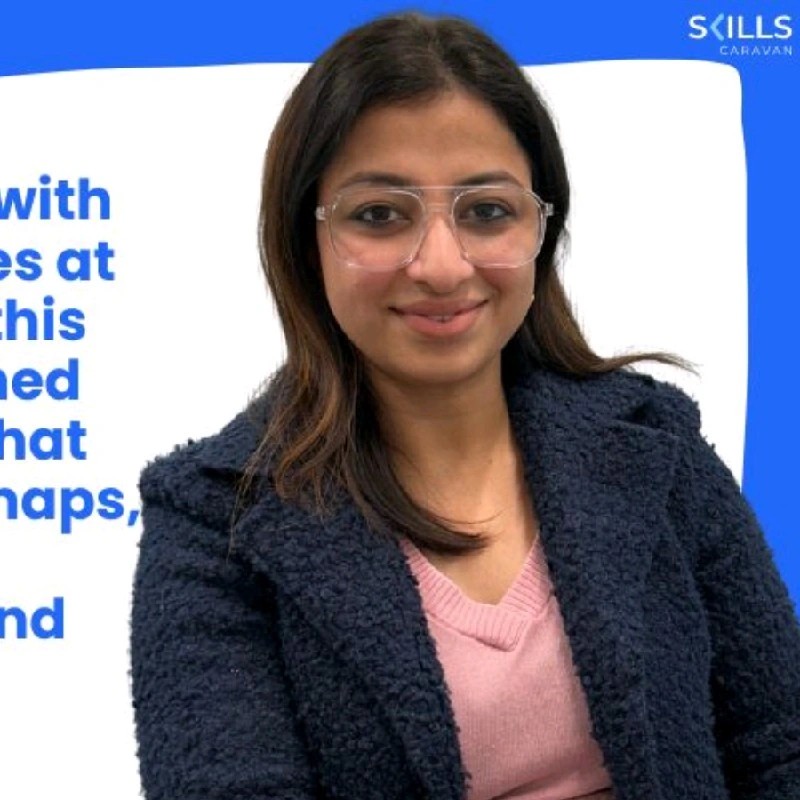

Shreya Verma is the VP of Product and Customer Success at Skills Caravan, where she leverages her decade-long expertise in learning & development (L&D) and human resources to shape an impactful, learner-centric platform. Her deep understanding of user needs, honed through hands-on L&D roles in leading companies, empowers her to translate insights into high-engagement interventions. At Skills Caravan, she bridges the gap between technology and people, ensuring learning experiences are not only effective but genuinely meaningful.











Skillsoft is a global leader in corporate learning, providing digital training and education solutions to help businesses improve workforce productivity, reduce risk, and increase innovation.

FinShiksha provides a practical and industry-relevant approach to finance education, with courses designed by industry experts and delivered through interactive and engaging methods.

Wall Street Prep offers best-in-class financial training for aspiring finance professionals and corporate clients.

Udemy Business offers an unparalleled learning experience for organizations looking to upskill their workforce with over 155,000 courses taught by expert instructors.


