


Skillsoft
Skillsoft is a global leader in corporate learning, providing digital training and education solutions to help businesses improve workforce productivity, reduce risk, and increase innovation.


In a world where the half-life of a skill keeps shrinking, the most valuable thing an employee can have is not what they already know — it is how fast they can learn something new and apply it well. That capacity to learn from experience and adapt to unfamiliar situations separates those who thrive through change from those who stall. It is a close cousin of good training and development, but it runs deeper than any single course.
This guide unpacks learning agility — what it means, why it predicts high performance, its five dimensions, and the practical strategies to build it across your workforce.
It is the ability and willingness to learn from experience and apply that learning to perform well in new, unfamiliar situations.
Not how much you know — how fast you learn and adapt when you don't.
The sections below cover its meaning, advantages, dimensions, how to develop it in employees, and the mistakes to avoid.
It is easy to confuse this capability with being a fast learner or simply being smart. It is subtler than either. Someone can absorb information quickly and still freeze when faced with a genuinely new problem; someone highly intelligent can lean so heavily on past expertise that they struggle when the old playbook stops working. The trait in question is specifically about the unknown — what a person does when there is no established answer to fall back on.
At its core, it is a loop: encounter a new situation, make sense of it, draw the right lessons, and apply them to act effectively — then do it again, faster, next time. Agile people actively seek out unfamiliar challenges rather than avoiding them, reflect honestly on what worked and what did not, and carry those lessons into the next situation. That is why it predicts performance in roles and conditions a person has never faced before.
The distinction that matters: intelligence is about what you know and how fast you reason; this is about how well you learn and adapt when you don't know. In a stable world, the first wins. In a changing one, the second does.
That shift — from valuing fixed knowledge to valuing adaptability — is why this has moved to the centre of how organisations identify potential. The next section explains why it matters so much now.
Why has learning agility become such a prized trait? Because it pays off in exactly the conditions modern organisations face every day — change, ambiguity, and constant new demands.
It is one of the strongest signals that someone will succeed in bigger, broader roles they have not held before — which is why it anchors so many high-potential programs.
Agile people adapt to new tools, markets, and ways of working faster, so the organisation absorbs disruption instead of stalling on it.
Put an agile learner in a new role, and they get up to speed quickly, because they are built to make sense of the unfamiliar.
Comfort with experimentation and fresh thinking means more new ideas tried, and more lessons banked from the ones that fail.
When skills go out of date fast, people who keep learning stay valuable — making adaptability the ultimate hedge against change.
In short, it is the capability that turns change from a threat into an advantage. The next question is what it is actually made of — its dimensions.
A widely used model breaks the capability into five dimensions. They turn a vague idea into something you can actually assess and develop — and most people are stronger in some than others.
| Dimension | What it is | Looks like |
|---|---|---|
| Mental agility | Comfort with complexity and fresh thinking | Enjoys hard problems; makes new connections |
| People agility | Understanding and working well with others | Reads people; adapts style to the room |
| Change agility | A liking for experimentation and change | Tries new approaches; comfortable with ambiguity |
| Results agility | Delivering under new or tough conditions | Gets results in unfamiliar situations |
| Self-awareness | Knowing one's strengths and blind spots | Seeks feedback; reflects honestly |
Someone strong across all five learns quickly and performs where others stumble. The dimensions also show that this is developable — each one responds to the right experiences and a supportive environment, which is far easier inside a strong learning culture.
Because it is a set of habits rather than a fixed trait, you can build it deliberately. The formula is simple: new, stretching experiences plus honest reflection — repeated over time.
Put people in roles and projects slightly beyond their current comfort zone. Novel challenges are where adaptability is built.
Working outside one's own function forces fresh thinking and people skills, exercising several dimensions at once.
After each project, ask what worked, what didn't, and what transfers. Reflection is what turns raw experience into a reusable lesson.
Regular, honest feedback builds the self-awareness that underpins the whole capability — and keeps blind spots in check.
People only take learning risks when mistakes are treated as data, not failures. Psychological safety is the enabler.
On-demand, personalised learning keeps curiosity fed and makes growth a daily habit rather than an annual event — the backbone of upskilling and reskilling.
The combination matters more than any single tactic: challenge builds the muscle, reflection locks in the learning, and a safe culture makes people willing to try.
The single most important idea for building adaptability is that experience alone does not create it. People can repeat the same kind of project for years and grow barely at all, because they never stop to extract the lesson. What turns experience into capability is the deliberate pause afterwards — the reflection that converts "what happened" into "what I now know".
New, varied, stretching situations — rotations, cross-functional work, unfamiliar problems. This is where the raw material comes from; comfort zones produce none of it.
Structured debriefs, coaching, and feedback that ask what worked, what didn't, and what transfers. This is where experience becomes a lesson you can reuse.
This is exactly why most growth happens on the job rather than in a classroom — the logic behind the 70-20-10 learning model. Design for both halves, and adaptability compounds; neglect reflection, and even rich experience goes to waste.
Use this to check whether your organisation is set up to grow learning agility rather than just hoping it appears on its own.
If most of these are missing, agility will stay rare and accidental. Put them in place, and it becomes a predictable outcome. A few common mistakes still undermine the effort — those are next.
Efforts to build adaptability stall for a handful of predictable reasons. Here are the ones to watch for.
Treating it as a fixed, innate trait.
Approach it as a set of developable habits — then design experiences to build them.
Giving experience with no reflection.
Build structured debriefs into every stretch project so lessons are actually extracted.
Punishing the mistakes that come with learning.
Create psychological safety — reward smart risks and treat failures as data.
Confusing it with raw intelligence or tenure.
Assess how people handle the unfamiliar, not how much they already know.
Keeping high performers in the same comfortable role.
Rotate and stretch them deliberately — comfort is where growth stops.
Avoid these, and adaptability becomes a reliable, growing strength across the workforce. The platform built to support all of this is the final section.
Building learning agility at scale needs a platform that makes continuous, personalised learning part of everyday work. That is what Skills Caravan is designed for.
On-demand, bite-sized learning that fits into real work keeps curiosity fed and makes growth a daily habit.
Recommends the right next thing for each person, nudging them into new areas rather than the same comfortable ground.
Surfaces gaps and adjacencies, so people see where to stretch next — the engine of competency-based development.
Helps L&D design the experiences and debriefs that actually grow adaptability, and track progress over time.
Makes continuous growth visible and rewarded, so the whole environment pulls people toward learning.
The result is an organisation where learning and adapting are continuous and supported — turning agility from an abstract goal into a daily habit across the workforce.
See how Skills Caravan makes continuous, personalised learning part of everyday work — growing the adaptability that keeps your people ahead of change. Book a live demo.
Book a demo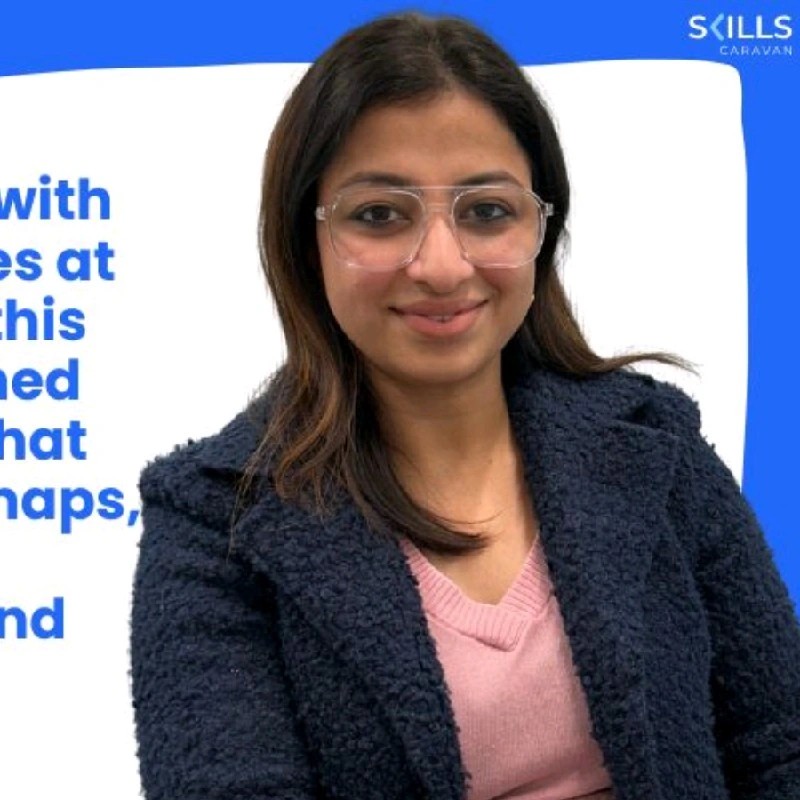

Shreya Verma is the VP of Product and Customer Success at Skills Caravan, where she leverages her decade-long expertise in learning & development (L&D) and human resources to shape an impactful, learner-centric platform. Her deep understanding of user needs, honed through hands-on L&D roles in leading companies, empowers her to translate insights into high-engagement interventions. At Skills Caravan, she bridges the gap between technology and people, ensuring learning experiences are not only effective but genuinely meaningful.










Skillsoft is a global leader in corporate learning, providing digital training and education solutions to help businesses improve workforce productivity, reduce risk, and increase innovation.

FinShiksha provides a practical and industry-relevant approach to finance education, with courses designed by industry experts and delivered through interactive and engaging methods.

Wall Street Prep offers best-in-class financial training for aspiring finance professionals and corporate clients.

Udemy Business offers an unparalleled learning experience for organizations looking to upskill their workforce with over 155,000 courses taught by expert instructors.


