


Skillsoft
Skillsoft is a global leader in corporate learning, providing digital training and education solutions to help businesses improve workforce productivity, reduce risk, and increase innovation.

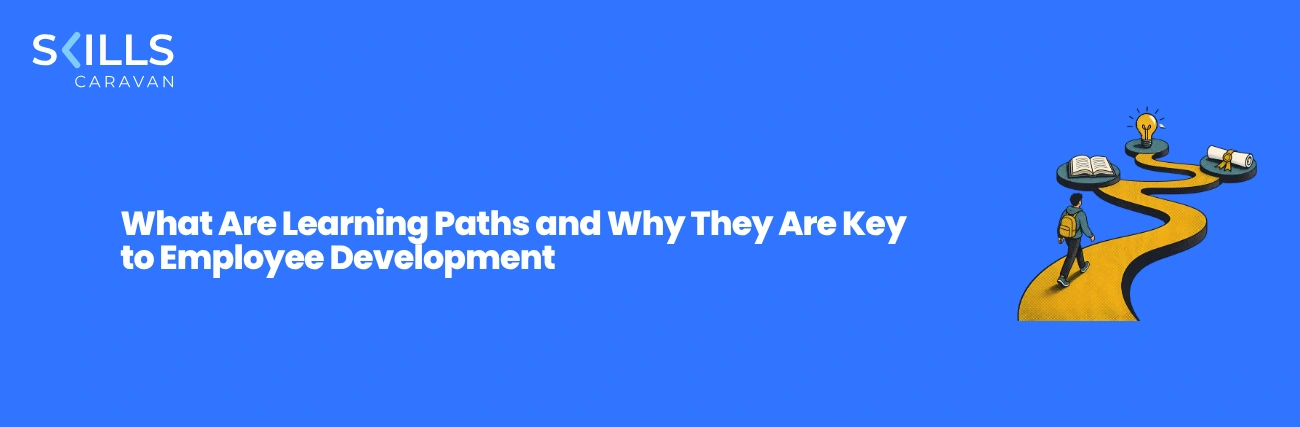

Give someone a library of five hundred courses and you have given them a problem, not a solution. Faced with that much choice and no order, most people take one course, lose momentum, and drift away. What turns content into development is direction — a clear goal, a sensible order, and visible progress toward it. That is what learning paths provide: they take scattered courses and arrange them into a guided journey with a destination. It is the same principle that makes personalised learning work — structure matched to the individual.
This guide covers what they are, why they matter for employee development, how to build effective ones, and the mistakes to avoid.
A structured, guided sequence of learning that takes someone from where they are to a defined goal — a skill, a role, a capability.
They turn a catalogue people browse at random into a journey with a destination.
The sections below cover what they are, why they matter, how to build them, a worked structure, the checklist, and the mistakes to avoid.
More content is not more learning. Past a point, it is less — because choice overload and no clear order make people stall before they start. The value of a path is not the content it contains but the direction it provides. The same courses, left loose, get abandoned; arranged into a journey with a goal and visible progress, they get finished. That shift from volume to direction is what makes development actually happen rather than just being available.
For learners, this makes growth feel achievable; for the organization, it ensures people build the right capabilities in the right order, consistently and at scale. The next section breaks down how to build one well.
The best learning paths are not the longest — they are the clearest. Follow these six steps and each path becomes a route people actually finish.
Define the destination — a skill, a role, a capability. Everything in the path should serve that one outcome.
Break the journey into the stages needed to reach the goal, from foundations to advanced, so each builds on the last.
Order the steps so learning compounds. Jumping around confuses; a clear progression carries people forward.
Select or build the right learning for each step, varied in format to stay engaging, and cut anything that does not serve the goal.
Show how far along the path a learner is and what comes next; visible progress is what sustains momentum.
Anchor the path to a role, skill, or career move so it clearly matters — then pilot, gather feedback, and refine.
Keep each path focused on one destination rather than trying to cover everything, and keep it current as needs change. The next section shows a worked example structure.
Here is a simple path for a new team lead, showing how stages build from foundation to applied. Use it as a template for any destination.
| Stage | Focus | Example content |
|---|---|---|
| 1. Foundations | The shift from doing to leading | Intro to the manager role; expectations |
| 2. Core skills | Everyday management basics | 1:1s, feedback, delegation |
| 3. People | Developing and motivating a team | Coaching, recognition, difficult conversations |
| 4. Performance | Setting and tracking goals | Objectives, reviews, accountability |
| 5. Applied | Putting it to work | Scenario practice; real-team project |
| Checkpoint | Confirm readiness | Assessment or manager sign-off |
Notice the logic: understand the role, learn the basics, apply them to people and performance, then prove it. The same shape works for any goal — and it slots neatly into an individual development plan. The next section is about acting on it at scale.
One path is easy; a library of paths that stays relevant for a whole organization takes a little discipline. These moves keep them useful as you grow.
Anchor each path to a real role or skill so it serves a genuine need — the heart of a skills-based learning strategy.
Let people skip what they already know and focus on real gaps, so the path fits the learner rather than forcing one route on everyone.
Build modular content that several paths can share, so you scale without rebuilding the same material repeatedly.
Resist cramming; one clear destination per path. Spin up a new path rather than bloating an existing one.
Visible milestones and recognition at the end sustain momentum and make finishing feel worth it.
Retire or update paths as roles and skills change, so the library never drifts out of date.
Do these and paths stay a living system rather than a set of playlists that slowly rot. Keep the quality high with the checklist next.
The highest-value use of a path is to make a career move explicit. "I'd like to become a team lead one day" is a wish; a path that shows exactly which skills to build, in what order, to get there is a plan. That shift — from vague ambition to concrete route — is motivating for the employee and valuable for the organization, because it channels development toward the roles the business will need filled.
A visible route from their current role to a target one, with progress they can track. Growth feels achievable and fair, and they can see they can advance without leaving — a strong reason to stay.
Capabilities built for future roles, stronger internal mobility, and better retention. Development is channelled toward real needs rather than scattered across whatever people happen to pick.
Career paths are also the natural home for the two directions of growth — building on strengths and moving sideways into new areas — the distinction covered in upskilling vs. reskilling. The checklist that follows keeps every path effective.
Run every one of your learning paths through this before you publish it. Pass all eight and the path will guide rather than overwhelm.
Tick these, and each path becomes a route people finish, not a playlist they abandon. A few common mistakes still derail them — those are next.
Paths fail in a few predictable ways — mostly by losing the very direction they are meant to provide. Watch for these.
Making a path too long or broad.
Keep one clear destination per path; spin up a new one rather than cramming everything in.
Poor sequencing that jumps around.
Order steps so each builds on the last, foundations before advanced.
Stuffing in content for completeness.
Curate ruthlessly; include only what serves the goal, and vary the format.
No clear goal or visible progress.
Give every path a real destination and show learners how far along they are.
Letting paths go stale.
Review and refresh as roles and skills change; retire paths that no longer fit.
Avoid these, and paths deliver the direction that makes development happen. The platform that makes them live and personalised is the final section.
The most useful learning paths are tied to real skills and roles and personalised to each learner — which is exactly what an AI-powered, skills-based platform makes possible. Here is how Skills Caravan does it.
Each path is built around the skills a role or goal needs, so it serves a real destination rather than being a hand-assembled playlist.
People skip what they already know and focus on their real gaps, so the path fits them rather than forcing one route on everyone.
Content is ordered from foundation to advanced with clear, visible progress, so learners keep momentum toward the goal.
Paths connect directly to target roles and internal moves — a skill gap analysis shows exactly what each one needs to close.
Capability gained along each path is measured, and paths refresh as roles and skills evolve, so the library never goes stale.
The result is paths that are living, personalised journeys tied to real growth — not static playlists — turning a catalogue of content into development people actually complete.
See how Skills Caravan builds personalised learning journeys tied to real skills and roles — with clear progress and a destination — so development actually gets finished. Book a live demo.
Book a demo

Shreya Verma is the VP of Product and Customer Success at Skills Caravan, where she leverages her decade-long expertise in learning & development (L&D) and human resources to shape an impactful, learner-centric platform. Her deep understanding of user needs, honed through hands-on L&D roles in leading companies, empowers her to translate insights into high-engagement interventions. At Skills Caravan, she bridges the gap between technology and people, ensuring learning experiences are not only effective but genuinely meaningful.







Skillsoft is a global leader in corporate learning, providing digital training and education solutions to help businesses improve workforce productivity, reduce risk, and increase innovation.

FinShiksha provides a practical and industry-relevant approach to finance education, with courses designed by industry experts and delivered through interactive and engaging methods.

Wall Street Prep offers best-in-class financial training for aspiring finance professionals and corporate clients.

Udemy Business offers an unparalleled learning experience for organizations looking to upskill their workforce with over 155,000 courses taught by expert instructors.


